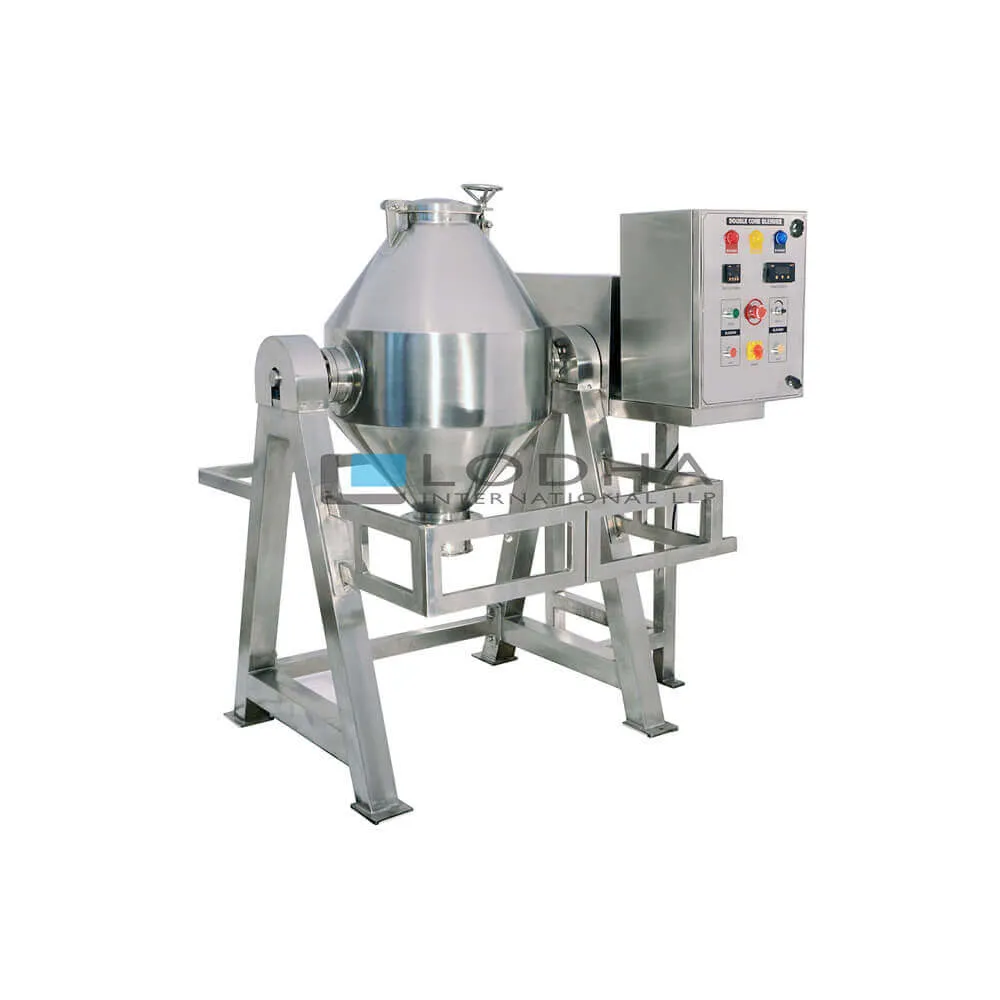
Lab Double Cone Blender

DCB is an efficient and versatile machine for mixing of dry powders and granules homogeneously. Lab model is used in laboratory for research work so it is also called as Lab Double Cone Blender. All the contact parts are made of stainless steel. The effective volume for optimum homogeneity is between 35-70% of gross volume. The Folding, Spreading and Cascading action of the double conical blender provides a rapid, homogeneous blending of dry and semi dry materials. The end over end revolving action, Moving materials in and out of a restricted are results in a through intermeshing of the products into a uniform mix. The Lab Double Cone Blender is used in laboratories for research and development due to which it is also known as R&D Double Cone Blender. It is also known by the names Mini Double Cone Blender, Small Double Cone Blender and Compact Double Cone Blender due to its small and compact size.

Batch Work capacities:


Range from Lab Model to production model (Up to 3500 Litres) based on fill level of 55% of total volume. Each blender design is customized to suit the customer’s specific requirements.

For Improved Blend Uniformity:


Special designs incorporating internal deflector cones, or angled shell bodies are available upon request.

Automated Drum Loading System:


Conical Blenders can be furnished with a PLC controlled automated drum loading system. With one full revolution of the blender, the entire contents of a product container (Fiber, Plastic, or Stainless Steel Drum) can be transferred into the blender and back into drums after mixing, in a dust free operation. This system eliminates costly mezzanine platforms, and other feed systems which require special docking mechanisms that create risk of spillage. During loading, the operator simply rolls the drum onto the roller conveyor, raises the lift to squeeze the drum against the valve discharge flange seal, and initiates the oad cycle. The blender slowly rotates one revolution while automatically opening and closing the valve, and stopping at the zero position. The empty drum is lowered, and replaced with a full container to repeat the cycle until all contents are charged. During discharging an empty drum is positioned on the roller conveyor and sealed against the valve discharge flange seal. The operator opens/closes the valve to fill the drum, lowers the drum, and replaces with an empty drum to repeat the cycle until all contents have been discharged.

Salient Features of Double Cone Blender:


  • PLC Controlled, Fully Automatic load and discharge function
  • Butterfly discharge valve is clamped to the blender outlet for quick disassembly and with Quick release design for ease of cleaning and maintenance. Valve Flange seal can be customized to suit the customer’s product container.
  • 0 Degree position for discharge is provided
  • Special PLC programming with safety interlocks for optimum operator safety
  • Shaft mounted gear motor installed via shrink disc coupler eliminates maintenance of traditional gear drive. Speed regulation via AC variable frequency.

Double Cone Blender Videos


Lab Double Cone Blender FAQs


It is a compact laboratory-scale powder blending machine featuring a double cone-shaped rotating vessel that tumbles pharmaceutical powders, Ayurvedic herbal blends, and nutraceutical formulations through gentle tumbling action — achieving homogeneous blend uniformity in small batch sizes for R&D, formulation development, and pilot production in pharmaceutical, Ayurvedic, and cosmetic manufacturing environments.

The double cone vessel rotates around its horizontal axis — tumbling the powder batch through continuous end-to-end and radial mixing motions that gently fold and recombine particles throughout the blend — achieving uniform powder distribution without the mechanical shear or particle damage that can occur with more aggressive blending equipment.

The double cone blender's gentle tumbling action is ideal for Ayurvedic herbal formulations because it blends delicate botanical particles, plant extracts, and multi-herb powder combinations without generating excessive heat, mechanical shear, or electrostatic charge — preserving the physical integrity and therapeutic potency of sensitive Ayurvedic herbal active ingredients during the blending process.

Yes, it is one of the most essential pieces of equipment in pharmaceutical R&D laboratories — used for developing and optimizing tablet and capsule powder blend formulations, evaluating excipient compatibility, conducting blend uniformity studies, and producing pilot batch blends for stability testing, analytical validation, and clinical trial material preparation.

Absolutely — nutraceutical formulation scientists and cosmetic powder product developers use lab double cone blenders to develop uniform vitamin and mineral supplement blends, beauty powder formulations, cosmetic color cosmetic blends, and wellness supplement powder mixes for pilot batch evaluation before scaling to commercial production blending equipment.

Laboratory double cone blenders are available in vessel capacities from 5 liters to 100 liters — covering the batch size range needed for small R&D formulation development, exhibit batch preparation for AYUSH licensing, clinical trial material blending, and small-scale initial commercial production in pharmaceutical, Ayurvedic, and nutraceutical manufacturing.

The machine blends free-flowing pharmaceutical powders, granules, herbal botanical powders, fine nutraceutical blends, multi-component Ayurvedic formulations, vitamin and mineral premixes, and cosmetic powder formulations — with optimal performance for materials with similar particle sizes and bulk densities that respond well to gentle tumble blending action.

Yes, it is manufactured with GMP-compliant SS 316 inner vessel construction with mirror-polished internal surfaces, SS 304 outer frame, and easily removable vessel design for thorough cleaning — meeting the material, hygiene, and surface finish standards required for AYUSH-licensed Ayurvedic and Schedule M pharmaceutical laboratory powder blending operations.

The double cone geometry creates three-dimensional powder movement during rotation — with powder cascading from both cone ends toward the central cylinder and back — ensuring all components in multi-ingredient pharmaceutical, Ayurvedic, and nutraceutical formulations are thoroughly intermixed to achieve the blend uniformity required for tablet weight uniformity and capsule fill consistency.

Blending times vary by formulation — typically ranging from 10 to 30 minutes at optimized fill volumes and rotation speeds — with blend uniformity validation studies performed using content uniformity sampling to confirm that each pharmaceutical or Ayurvedic formulation achieves the required degree of homogeneity within the established blending time parameters.

Yes, the gentle tumbling action of the double cone blender is ideal for lubricant addition — with magnesium stearate and other tablet lubricants added in a final short blending step after the main blend is homogeneous, preventing over-lubrication that can occur with more aggressive blenders and maintaining optimal tablet compression properties.

A validated lab double cone blender with documented blending parameters and blend uniformity data provides the formulation development evidence required by AYUSH licensing authorities — demonstrating that Ayurvedic multi-herb powder formulations achieve consistent blend homogeneity in pilot batches that can be reproduced during commercial scale manufacturing.

The optimal fill volume for a double cone blender is typically 40 to 60% of the total vessel capacity — this fill range allows adequate powder movement and tumbling action throughout the blending cycle, with insufficient fill levels causing poor mixing and overfilling preventing effective powder cascade and blend homogeneity.

Yes, laboratory double cone blenders can be operated in controlled humidity environments or fitted with nitrogen blanketing systems — protecting moisture-sensitive Ayurvedic herbal powders, hygroscopic pharmaceutical excipients, and humidity-sensitive nutraceutical formulations from atmospheric moisture exposure during the blending process.

The double cone vessel features smooth mirror-polished SS 316 internal surfaces and a large removable access port — enabling thorough manual or CIP cleaning between product batches, with cleaning validation swab and rinse sampling straightforward due to the accessible vessel geometry and smooth surface finish required for multi-product pharmaceutical and Ayurvedic laboratory blending operations.

The machine features variable speed control — typically adjustable from 5 to 25 RPM — allowing operators to optimize rotation speed for different powder densities, particle sizes, and blend formulation types, with lower speeds preferred for fragile Ayurvedic herbal particles and higher speeds used for dense pharmaceutical granule blend homogenization.

No, the double cone blender is specifically designed for dry powder and granule blending — wet granule mixing is performed in separate planetary mixers or granulators — however, the double cone blender is commonly used after fluid bed or tray drying to blend dry granules with extra-granular excipients and lubricants before tablet compression or capsule filling.

The lab double cone blender has a compact footprint suitable for standard pharmaceutical and Ayurvedic laboratory spaces — operating on a 220V single-phase or 440V three-phase power supply — with laboratory-scale models requiring minimal floor space and utility connections, making them accessible for small pharma R&D labs, Ayurvedic formulation centers, and nutraceutical development facilities.

Yes, Lodha Pharma provides complete on-site machine installation, operational training for laboratory staff, blending parameter guidance, cleaning validation methodology support, IQ/OQ documentation assistance, and prompt spare parts and seal replacement availability — ensuring your lab double cone blender delivers consistent and reliable powder blending performance for all your pharmaceutical, Ayurvedic, and nutraceutical formulation development needs.

Simply contact Lodha Pharma through their official website with your required vessel capacity, powder formulation type, blending batch size, GMP laboratory requirements, and facility details — their knowledgeable technical sales team will promptly provide a competitive and tailored quotation and arrange a convenient live demonstration or detailed product walkthrough to help you select the ideal lab double cone blender for your pharmaceutical, Ayurvedic, or nutraceutical formulation development and pilot production requirements.

What Our Clients Say About Us?


Our clients' feedback is always important for our growth.

Related Products


Scan the QR to call