Get in touch! +91 9687731331 | +91 9687631331 |


Get in touch! +91 9687731331 | +91 9687631331 |
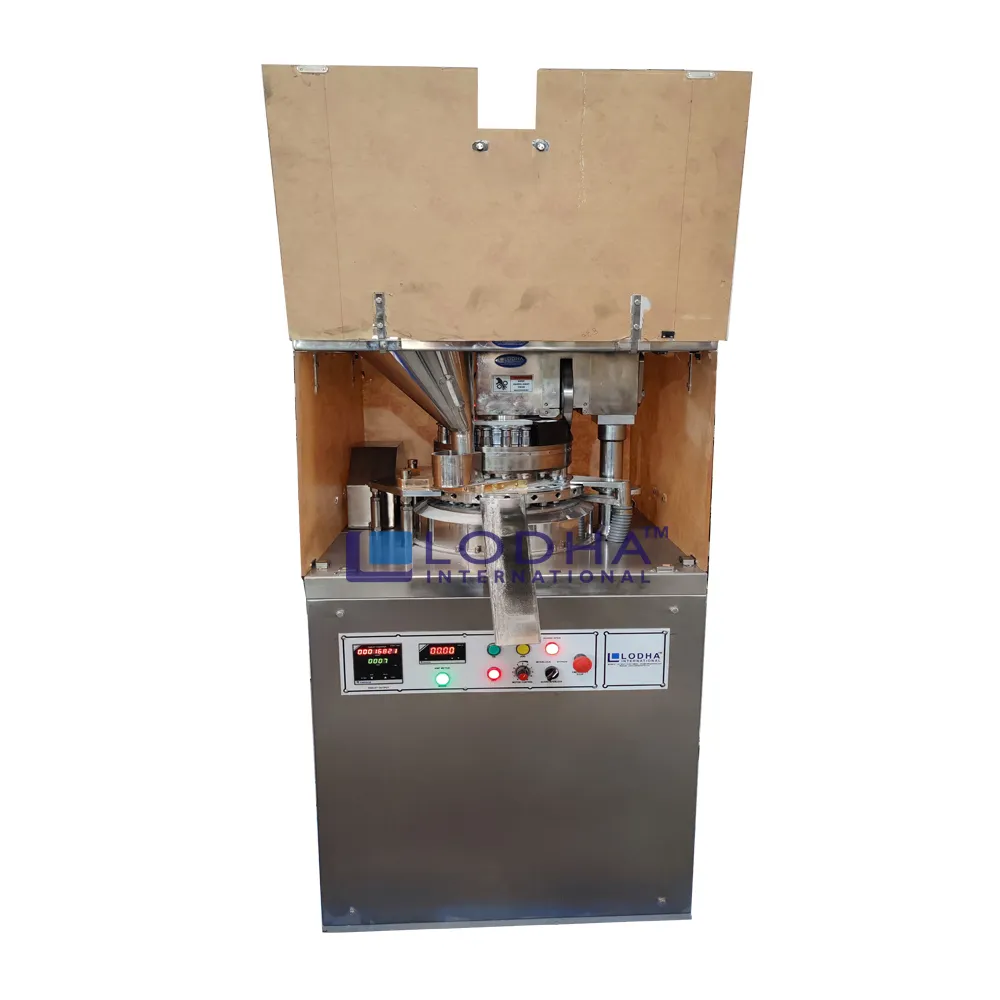
GMP model LI-ST Single Sided Rotary Tablet Press Machine is an entry level tablet press. It is specially designed for the small production batches. This machine model is suitable for a variety of applications in pharmaceutical and other industries like food, chemical, naphthalene, confectionery etc. Manufacturer of Single Sided Rotary Tablet Press Machine is used in laboratories for research and development due to which it is also known as R&D rotary tablet press machine. It is also known by the names mini rotary tablet press machine, small rotary tablet press machine and compact rotary tablet press machine due to its small and compact size.
The suitable model can be selected based on the tooling and output requirement from the 16 & 20 stations with the “D”, “D” & “B/D” tooling respectively.
Tablet Press model of 12 station is also available with special tooling and tunnel type can track having max lab Diameter of 40 mm & max depth of fill of 30 mm.
Unlike other forms of compression devices, rotary tablet presses have the ability to independently control the amount of powder in the cavity. In addition, they offer higher productivity and minimal labor. They are also easy to clean.
The main components of a rotary tablet press are a take-off blade, feeder, and a hopper. In addition, the machine has a lubrication system that is designed to maintain the main pressure and pre-pressure.
The die system in a rotary tablet press is designed to accommodate a variety of tablet sizes. The machine is also equipped with an ejection adjuster that helps to eject tablets from the die cavity. The depth of fill control is another feature that ensures that the right quantity of granules are present in the cavity before the machine is engaged in compression.
The machine is made in compliance with CGMP standards. It has a touch screen control panel that displays important operating parameters. It is manufactured from 316 stainless steel and is easy to clean.
The machine also features a hydraulic overload system. An ammeter is attached to the control panel to indicate if the machine is under overload. If the machine over loads, it automatically stops.
The main compression process is achieved by a synchronized motor. The motor is fitted with a variable speed pulley mounted on the Motor shaft. It is also equipped with a hand pump for automatic lubrication.
The rotary tablet press machine is capable of producing up to nine thousand - two hundred and thirty four thousand tabs per hour. The production capacity of the machine depends on the number of compression stations, the distance between the top and the bottom punches, and the thickness of the tablets.
Basically, a tablet compression machine is a machine that compresses powder into tablets. The machine is made up of two critical parts: the feeder and the die. A good feeder system will ensure proper flow of the powder mix from the hopper to the die system. It should be 316L stainless steel to avoid clogging. It also needs to be dust tight.
The feeding system is composed of several components. The main components are the hopper, the take-off blade, the feeder housing, and the die table. The hopper should be fitted perfectly. It should be designed to fit into the turret's holes.
The feeder housing is fitted with a take-off blade. It guides the granulated powder mix from the hopper to the die area. The material is then compressed by the upper and lower punches. The bottom punch is raised to eject the material.
The rotary tablet press has a unique working principle. It uses overfill principle to compress powder into tablets. The turret is the heart of the press' tooling. The turret holds many punches. The height of the bottom punch is controlled by a metering cam. This is used to improve the release features of the press.
The ejection cam also allows ejection of the tablet from the die cavity. A servo-motor system is used to make these movements possible. The ring is a Courtoy die ring. It is a replacement for the conventional die. It improves the number of tablets produced per revolution. It reduces setup time and allows uninterrupted access to the die ring.
| Model No. | LI-ST12 | LI-ST16 | LI-ST20 |
| Number of Station | 12 | 16 | 20 |
| Type of Tooling | Special Type | ‘D’ | ‘D’ |
| Output | 15,840 Max. | 13,400 – 40,220 | 16,800 – 52,000 |
| Max. Operating Pressure | 12 Ton | 10 Ton | 10 Ton |
| Max. Tablet Diameter | 40 mm | 25 mm | 25 mm |
| Max. Depth of Fill | 30 mm | 20.5 mm | 20.5 mm |
| Upper Punch Entry Penetration | 1.5 – 8 mm | 1.5 – 8 mm | 1.5 – 8 mm |
| Main Electric Motor | 3 H.P.,950 RPM, 415 Volts, 50 Hz | 3 H.P.,1440 RPM, 415 Volts, 50 Hz | 3 H.P.,1440 RPM, 415 Volts, 50 Hz |
| Overall Dimension | 980 mm x 1020 mm x 1820 mm | ||
| Net Weight | 1200 | 1100 | 1100 |
Our clients' feedback is always important for our growth.
We've been using the Manual Capsule Filling Machine from Lodha International LLP for months now. It's efficient and easy to operate. Great value for the investment!
The Automatic Capsule Loader from Lodha International has transformed our production process. It saves us so much time and provides consistent results. Highly recommend it!
Our production line is working much more smoothly, thanks to Lodha International LLP and their Ampoule Filling & Sealing Machine. It's built to last, and the results are always precise.
Our packaging process has never been more efficient since we invested in Lodha International LLP's pharmaceutical packaging machinery. The machinery is reliable and user-friendly. We couldn’t be happier.
We switched to the Automatic Capsule Filling Machine from Lodha International LLP, and the difference is clear. The machine delivers exceptional precision and speed. It greatly enhanced our industrial productivity.
We’ve been using the Manual Capsule Filling Machine for several months and are very impressed with its performance. It's robust, easy to maintain, and ideal for our needs. Highly satisfied with Lodha International LLP.
The Automatic Capsule Loader from Lodha International revolutionizes the industry. It increased our production speed significantly while reducing human error. It is an excellent investment for any pharma company.
We’ve been using Lodha International LLP’s Ampoule Filling & Sealing Machine for a while, and it has exceeded our expectations. The machinery is highly effective in our filling processes.
The Pharmaceutical Packaging Machinery from Lodha International LLP has greatly improved our packaging line. It’s efficient, high-quality, and easy to integrate into our existing system. Highly recommend their products!
We recently upgraded to the Automatic Capsule Filling Machine from Lodha International LLP. The machine is fantastic—fast, precise, and cost-effective. It has made an important difference in our manufacturing quality.
The pharmaceutical machinery from Lodha International LLP. has completely transformed our production line. Excellent performance and long-lasting quality—highly recommended!
Exceptional quality and service! The pharmaceutical machinery delivered consistent output and helped streamline our processes.
Scan the QR to call